
The Part of the Kentucky Derby You Don’t See
When people think of the Kentucky Derby, they think about the race.
Two minutes.
A blur of speed.
A finish line.
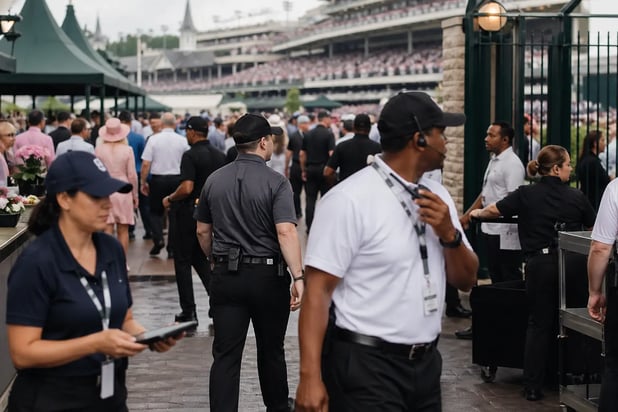
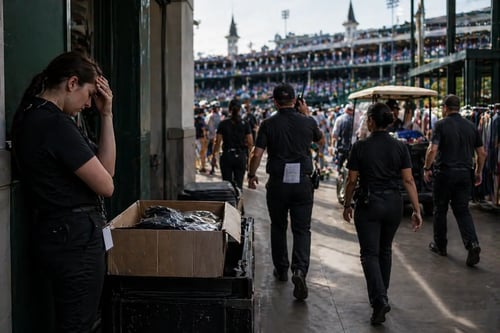
What they don’t think about is the thousands of people working before, during, and after those two minutes.
Hospitality staff moving nonstop.
Operations teams coordinating across multiple zones.
Vendors, security, logistics, transportation, guest services.
Every one of them represents the event.
And every one of them is wearing a uniform that has to hold up under pressure.
Where Most Uniform Programs Quietly Fail
Providing uniforms for a large event doesn’t usually fail in obvious ways.
It fails in small, compounding ones.
- A size run that looked right on paper, but doesn’t match the workforce
- A fabric that feels fine in a showroom but struggles after eight hours outside
- A delayed shipment that forces last-minute substitutions
- Slight color inconsistencies that become noticeable at scale
None of these issues feel catastrophic on their own, but when thousands of people are involved, they stack fast.
That’s when a uniform program stops supporting the operation and starts working against it.
Scale Changes Everything
Designing a uniform for a small team is one thing.
Scaling that same idea across hundreds or thousands of people introduces a completely different set of challenges.
At the Derby level, you’re not just designing for:
-
One role
-
One environment
-
One timeline
You’re designing for:
-
Indoor and outdoor conditions
-
Day shifts and night shifts
-
Customer-facing and operational roles
-
Teams that may never interact but still need to feel connected
The uniform isn’t just clothing at that point.
It becomes infrastructure.
The Pressure Test: One Day, No Margin for Error
Unlike ongoing programs, events don’t give you time to adjust.
There’s no “we’ll fix it next week.”
Everything has to work:
- On the right day
- At the right time
- For the right people
If something goes wrong, it’s visible immediately.
A missing shipment isn’t just a delay.
It’s a team without the tools they need to do their job.
A poorly performing garment isn’t just uncomfortable. It affects how someone moves, works, and interacts with guests.
At this level, uniforms directly impact experience.
What Actually Makes a Program Work
When you zoom out, successful large-scale uniform programs aren’t built on a single great design.
They’re built on alignment across multiple moving parts:
1. Design That Anticipates Reality
Not just how something looks, but how it performs over time, across environments, and under stress.
2. Sourcing That Can Scale Without Compromise
Consistency matters more at volume. The same garment has to show up the same way, every time.
3. Inventory Strategy That Accounts for Uncertainty
Because last-minute changes aren’t the exception. They’re the rule.
4. Distribution That Doesn’t Break Under Pressure
Getting product to the right place isn’t logistics. It’s execution.
5. Program Oversight That Connects It All
Without structure, even strong individual pieces fall apart.
Why Events Like This Matter (Even If You’re Not the Derby)
Most organizations aren’t making uniforms for an event this size.
But the same pressure points show up in different ways:
- Multi-location teams
- High turnover environments
- Rapid growth
- Seasonal spikes
The scale may seem different.
The complexity doesn’t.
Where Affinity Comes into Play
The Kentucky Derby lasts only two short minutes. The preparation behind it takes months.
Uniform programs follow a similar pattern. The organizations that get it right aren’t reacting in the moment; they’ve already solved for it.
At Affinity, uniform programs are built to operate in environments where consistency, speed, and scale matter.
With global capabilities, over 40 manufacturing partners, and support for more than 5 million wearers, programs are designed to handle complexity without losing control.
Because at a certain level, uniforms stop being about apparel, and they become part of how the operation runs.
If your uniform program only works when everything goes according to plan, it’s not built for scale.
And at the highest levels, things rarely go according to plan.
If your uniform program is being tested, it should be built for it. Let’s take a closer look at how your current program is performing and where it can improve.
👇 Connect with our team today to enhance your uniform program.